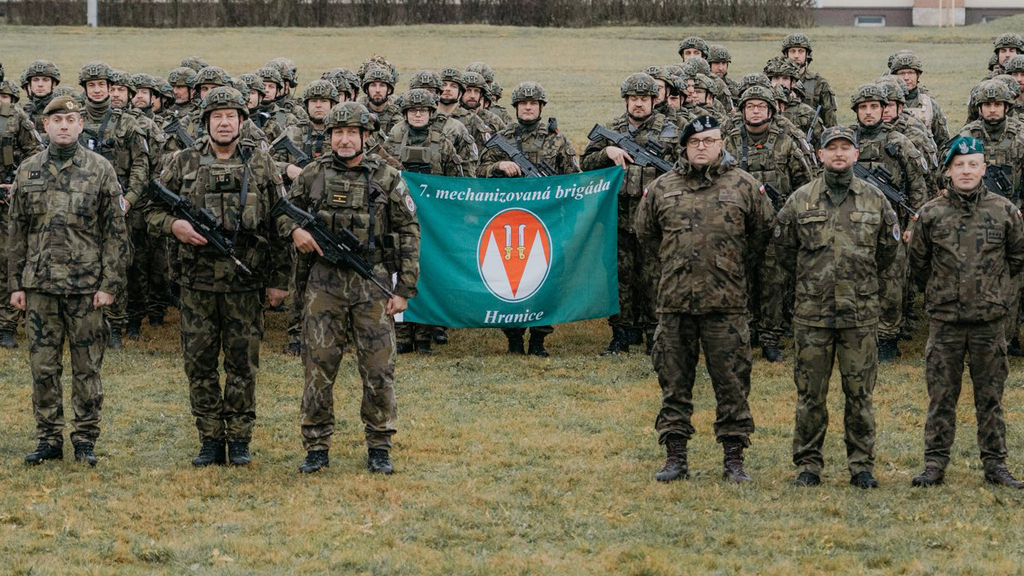
After a twelve-month preparation, the Czech Armed Forces 7th Mechanised Brigade homebased in Hranice achieved a key milestone in its modern existence. The 7MechBde has just successfully completed the command post exercise Amber Lionheart, which proved the Brigade’s readiness to operate in the structure of the Multinational Division North East and its ability deploy for NATO Article V collective defence operations. The exercise focused on command and control processes without full deployment of all units in the field.
“As part of the certification process, the Brigade command proved the ability to plan and control operations by a combat task force within the Multi National Division North East. The Czech Armed Forces thus proved the ability to meet NATO commitments by participating in collective defence,” Lieutenant General Václav Vlček underscored.
The performance was highly positively evaluated by foreign representatives. “Cooperation with the Czech Armed Forces 7th Mechanised Brigade is for us an excellent example of outstanding interoperability and high professionalism. Their performance meets the NATO standards,” said Major General Jarosław Górowski, Commander Multi National Division North East.
An Article 5 scenario. Combat situation, decision-making under pressure and command in the operational tempo of contemporary conflicts
The training primarily took place in Hranice and Drahotuše, where the staff worked in the mode of a continuously simulated operation. In parallel, there was a team of officers from the Brigade’s command assigned to HQ MND-NE in Elbląg, Poland, who coordinated forces in the combined area of operations. The scenario was designed to escalate from defence operations to counterattack, including under the conditions of hybrid and kinetic threats. A high premium was placed on the coordination among subordinate components, speed of decision-making, adaptability to the changing situation and to maintaining a high degree of interoperability with Allies.
The specificity of exercise Amber Lionheart 25 was that the 7th Brigade Task Force led the operation simultaneously from the main command post and the combat support centre. The main command post controlled the brigade manoeuvre, communication with the superior division and with adjacent brigades in the order of battle. The combat support centre was concurrently in control of support and sustainability of the whole operation – they observed the course of the battle, force status, logistics, medical support, movements and resupply. “This configuration corresponds to the way the task force would be employed in real conflict and enabled the evaluators to verify both the ability to plan operations as well as to sustain combat readiness of assigned forces," explained Colonel Radek Šoman, the Chief of Staff of the 7th Mechanised Brigade.
The integration of the whole Brigade Task Force was another important part of the training exercise. The operation did not involve just the 7th Mechanised Brigade as the heavy brigade core, but also assigned combat service and combat service support components from across the Czech Armed Forces – artillery, engineer, CBRN, reconnaissance, GBAD, signals, logistic and medical elements as well as Joint Terminal Attack Controllers (JTAC). All those components had to be incorporated into a single plan, harmonised in time and space and controlled from both command posts as a single force.
Advanced simulation technology enabled the verification of command processes and established procedures, response to contingencies and continuity of the decision-making process. NATO evaluators observed the way the staff works with battlefield data, how they communicate with NATO partners in timeframes typical for high intensity conflicts. “In the environment of modern conflicts, it is not just about technology and modern equipment. The key factor is a highly ready staff plus the ability to fuse, respond and take decisions. Our service members proved they have what it takes,” COL Šoman underlined.
For more pictures see this page.