21.5.2026
Eyes on the Ground: Joint Terminal Attack Controllers Guiding Air Power from the Front Lines
There are just a couple dozen of them in the whole Czech military. No one is allowed to know what they look like. And yet they hold the key to one of the most expensive and lethal weapons on the modern battlefield — the fighter jet. This September, these elite service personnel from around the world will gather in the Czech Republic for Exercise Ample Strike 2026.
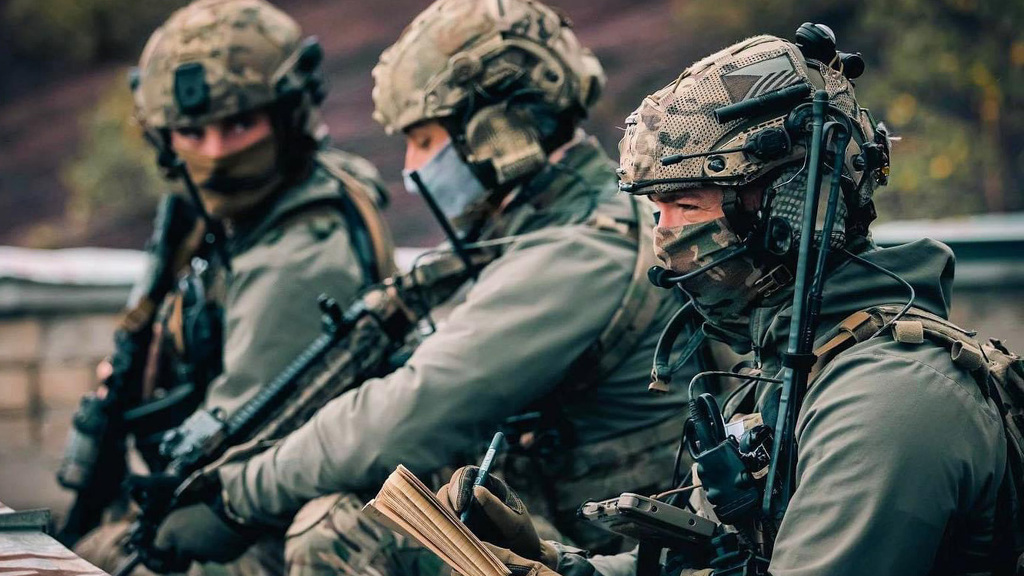
Imagine the scenario: an infantry patrol advances through a devastated village, gets into contact, and have no way to attack the opponent’s fortified position. They fall back behind the corner of a building. The commander knows there is an aircraft circling overhead. But how do you tell the pilot exactly where to strike — to the meter, without losing your own men? This is precisely where one of the most important and least visible specialists of the modern military enters the picture: the Joint Terminal Attack Controller (JTAC).
The Voices That Guide Aircraft
A JTAC is a servicemember positioned directly on the front line – or behind it, or at a command post — who acts as the intermediary between infantry on the ground and pilots in the sky. He is not merely a liaison. He is a living computational system, a tactical strategist, and in critical moments, a saviour of both friendly and non-combatants’ lives alike.
His primary tool is the so-called nine-line brief (9-liner) – a standardized method of conveying target information that is intelligible to pilots worldwide, regardless of nationality. Within seconds, the JTAC communicates the target location, target description, danger zones, approach altitude, and method of target designation. The pilot then strikes. Everything takes place in English, monitored by radio and radar, every step recorded.
But the reality is more complex than it appears on paper. The JTAC must be capable of simultaneously managing vertical and horizontal separation for multiple aircraft at once – for instance, synchronizing an airstrike with artillery fire at the same time. He works by day and by night, in rain and thick smoke, under fire. For every bomb that falls, he bears full responsibility.
Lords of Thunder: the anonymous elite
In the Czech Armed Forces, these controllers carry the nickname Lords of Thunder.
They operate in combat zones or in enemy controlled territories. They rank among the military’s elite, and because of the hazardous nature of their service, the Armed Forces conceal their identities. Their numbers within the Czech Armed Forces amount to only a few dozen – fewer than the members of many special operations units. Yet their influence on the outcome of operations is often decisive, particularly in the conditions of integrated modern battlefield.
The JTAC unit was established in the Czech Armed Forces relatively recently, in 2001, in Náměšť nad Oslavou. Since then, thanks to considerable combat experience and a hard-won reputation, it has become a high demand low density asset to the military – one whose cutting-edge capabilities are also recognized and valued by the NATO Allies.
Czech JTACs gained their combat experience primarily in Afghanistan, where the guidance of aircraft took place in real combat conditions. They directed U.S. Air Force F-15s, F-18s, the legendary A-10 Thunderbolt II ground-attack aircraft, and Predator drones with laser-guided bombs onto their targets.
What it takes to pass selection
The path to earning the JTAC badge is not a short one. Fluent English communication and excellent physical fitness are the baseline for any JTAC. Candidates face advanced English testing, physical fitness assessments, performance under stress evaluations, and aptitude examinations.
Only after successfully completing selection do candidates begin basic training, followed by certification at a U.S. training center for air and artillery controllers – or through a national accredited program. Only the best make it through and earn full NATO certification, without which no one can deploy for a multinational operation or perform this role in any capacity.
The results speak for themselves. Czech forward air controllers have successfully directed two GBU-12 laser-guided bombs from a single aircraft onto two separate targets simultaneously – a type of training that is not commonly practiced. And one Czech instructor became the very first Czech service member to receive the U.S. Air Force Commendation Medal, awarded for training more than 500 allied controllers.
The bridge between earth and sky: JTAC as the backbone of air support
Air power is impressive on its own – fighter jets, attack helicopters, surveillance drones. But without precise guidance from the ground, its impact is limited or outright dangerous. Pilots flying at several thousand meters cannot see what a soldier in the dust below can see. This is precisely why JTACs are an indispensable component of air forces in the service of ground forces.
This capability, known as the Close Air Support (CAS), forms the bridge between two worlds. Without it, aviation can still patrol and strike strategic targets. But without a JTAC, it cannot respond effectively to the developing tactical picture directly on the battlefield – precisely where the outcome of an engagement is decided.
NATO regards this capability as critical and systematically trains and standardizes it across all the Nations’ armed forces. In the Czech Republic, this effort culminates each September in one of the largest air exercises held on the Czech soil.
Ample Strike: An Exercise Born of Necessity
Exercise Ample Strike came into being in response to a clear need: controllers from different NATO nations must share the same procedures, communicate in the same language, and trust each other. For years, Ample Strike has been a cornerstone of JTAC training and preparation. Through it, the Czech Republic actively contributes to enhancing the capability and professionalism of its armed forces while strengthening its role within NATO.
The exercise has grown steadily since its inception. Ample Strike stands among the leading training events focused on guiding rotary and fixed-wing pilots to engage targets with maximum precision and effectiveness. Today it is one of the largest exercises of its kind in the entire NATO Alliance.
The eleventh edition in 2024 involved more than 500 service personnel, including 200 international participants from 14 NATO nations. The exercise took place across multiple locations, including the Boletice and Libavá Military Training Areas, the 21st Tactical Air Force Base at Čáslav, and the civilian airport in České Budějovice.
The 2024 iteration brought an unexpected challenge: the Czech Republic was struck by extensive flooding. The Armed Forces did not halt the exercise – it adapted it. An MQ-9 Reaper drone monitored and searched the flooded regions of the Moravian-Silesian Region, demonstrating Ample Strike’s reach into civilian emergency preparedness.
Deliverables for the Czech Armed Forces and NATO
The benefits of Ample Strike are concrete and measurable. It brings together controllers from dozens of nations who not only practice technical procedures but also build personal relationships and mutual trust – invaluable in a real operation.
Each edition tests the Czech Republic’s ability as a Host Nation – its capacity to receive allied forces and provide them with facilities, infrastructure, and logistic support. This is a commitment the Czech Armed Forces has made to NATO, and one that Ample Strike proves, year after year, is being kept.
The exercise also serves as a testing ground for new tactics: airfield manoeuvres from civilian airports, operation control from the Air National Command Center in Stará Boleslav, integration of unmanned systems, and – for the first time – the involvement of Active Reserve Component pilots. Each edition raises the bar a little higher.
“I have worked with JTACs from all over the world and found that the Czech ones are incredibly professional and ferocious fighters,” remarked a U.S. servicemember after the 2024 iteration.
Ample Strike 2026: September in sight
The twelfth edition of Ample Strike will take place in September 2026 — as tradition dictates, once again with international participation from NATO nations.
Above the training areas, skill and technology will once more be put to the test. The Czech Armed Forces will assign its proven L-159 ALCA aircraft from the Čáslav base — fast, agile subsonic jets designed, among other roles, specifically for close air support of land forces. Multirole helicopters and transport assets will also be present.
Aviation enthusiasts, however, can also look forward to aircraft from other NATO nations, the exact composition of which will be confirmed ahead of the exercise. In recent editions, German Eurofighter Typhoons, American MQ-9 Reapers, Apache helicopters, and many other platforms have cruised Czech skies. For the JTACs on the ground, each one presents a different challenge, a different approach, a different procedure.
And that is precisely the point of Ample Strike: to practice working with everyone, so that when the real situation arises, everything functions without hesitation.
Technology advances, but humans remain essential
The Czech Air Force continues its generational renewal of equipment and hardware. The era of Soviet-era technology is drawing to a close, replaced by modern platforms suited for the digital battlefield. New H-1 helicopters (Viper and Venom), modernized CASA C-295 aircraft, the SPYDER air defense system. The Czech Armed Forces is modernizing at a pace unseen since the Cold War. And on the horizon, the future is taking shape: the first F-35 Lightning II jets in Czech service, which are slated to progressively replace the Gripens.
But regardless of how sophisticated the aircraft that takes to the sky may be – whether it is a fifth-generation fighter or the most advanced unmanned system – someone must guide it. Someone must stand on the ground, eyes on the target, make the decision, and accept responsibility. When human lives are at stake, the final word must always belong to a human being.
That someone is the JTAC. The lord of thunder. The pilot’s eye on the ground.
- For more pictures see this page.