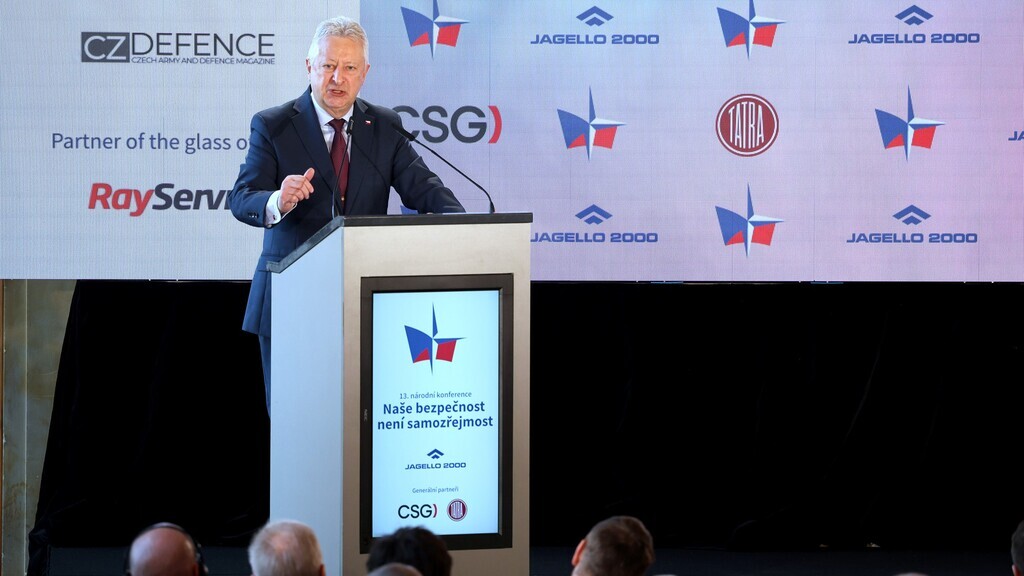
The Prague Castle was the venue to the 13th edition of the conference titled “Our Security cannot be taken for Granted”. Since 2014, the conference has been a regular meeting point for political leaders and prominent security experts to review the development and outline plans for the next course of action in providing the Czech Republic’s national defence and security posture. The keynote speakers included Czech Defence Minister Jaromír Zůna.
Excellencies, distinguished guests, ladies and gentlemen.
I am delighted to attend this conference and to have the opportunity to salute you on behalf of the whole Czech Ministry of Defence in the role of the Defence Minister. I am very grateful to the Chairman of Jagello 2000, Mr. Zbyněk Pavlačík, for having invited me.
I would also like to thank the organisers and supporters for organising this conference that has already become a traditional event in our schedules. I trust we are all proud, as citizens and representatives of the security community, that an event like this is held in the Czech Republic, moreover hosted in the beautiful premises of the Prague Castle.
I am also using this opportunity to thank very much all service personnel and defence civilians of the Ministry of Defence, who were involved in planning, preparing and executing the operation that evacuated our citizens from the Middle East region under crisis.
The Czech Armed Forces performs missions and has available systems, support and conditions we have never dreamt of in the past. This is great news as we perceive the negative development trend in the security environment and the ever broader variety of risks and threats such development poses to our country.
In line with the program statement of our Government, it is our aim to provide national security, stability of public finance and a functional state capable of protecting its citizens even in crisis situations. National defence is one of the Government’s key priorities in this context.
Current conflicts and crises show the criticality of, for instance, high-quality air defence, strategic stockpiles of ammunition, operational public warning system, well-exercised emergency management system as well as resilient society and infrastructure, new operational domains and the like. Those areas rank among the Government’s priorities and the present ongoings prove that they are well identified. The prepared ground-based air defence concept focuses on covering critical defence infrastructures and population protection and envisions building multilayer air defences to cover the whole state territory. The associated expenditures will be very high. We need to achieve consensus to be willing and able to allocate and reasonably invest the funding. Therefore, we must not reduce the perspective of the requirement for building our armed forces and strengthening national defence and security down to formal indicators. We should rather proceed using practical measures realised in acceptable timeframes, which will indeed strengthen our military and answer the current national security requirements.
What comes to my mind in this respect is one rare text by Professor Matlary, which entertains reflexions, forces and interests in transatlantic relations between Europe and the United States, where she wrote already back then: “Military power is employed more than in the Cold War era and is utilised as a Clausewitz instrument of policy; it is employed along with other instruments in an increasing number of countries.” That was in 2004.
In retrospect, we have now witnessed a true escalation of strategic competition on the global scale, while incoming multipolarity sees rivalry push out cooperation, international standards and rules questioned, commodities and process securitised – that has been discussed by the Vice Prime Minister – which are essential for socio-economic stability of the state and provision of national security, as new vulnerabilities and dependencies surface as a result. At the same time, the United States have taken steps in line with their strategy for Europe to bear the brunt of responsibility for the security of its region, all of which forces both NATO and the EU to adapt and to change approaches and policies.
Although this need not necessarily have been the case should we have consistently adhered to traditional conservative schools of building military and providing national security and defence and should we have not been carried away by arguments for momentary purposes to which we subordinated practically everything through the perspective of the DOTMLPFI methodology – military personnel and you all know what the acronym means. That is why seeking a new balance in the system costs us so much effort, resources and political implications. That is the balancing Minister Havlíček spoke about.
The quality of strategies is always based on whether we are able to ask ourselves the right questions. I hope we will be able to incorporate the right questions in the contents of the newly developed concepts of the Ministry of Defence. For example, one such questions is, in identifying the long-term direction of the armed forces development, what is based on defence spending and what is directly not.
While defence spending grew by 400 % between 2014-2025, why did it not reflect adequately in combat value and readiness level and modernisations of the armed forces? Why are we presently not achieving the tempo of modernisation and armed forces developments we had in the first five year of transitioning to all-volunteer force for example? And I could pose many questions like that. While we were able to plan the building of the heavy brigade with budget around CZK 80 billion, when the budget sprang up to 160 billion, we postponed the realisation of a variety of measures by eight years. The answers to these questions naturally do exist. But not in the form of phrases, but in the form of data and facts.
In this connection, I recall a discussion between Michail Gorbachev and Margaret Thatcher in an international forum, where she said: “If the natural relation that countries’ wealth depends on raw material resources would apply, Russia would be a paradise and Hong Kong a village of fishing huts today. But it is completely the other way round, because it is mainly about the life we decide to live.” And it is about such principal questions.
We have essentially known for a long time that the potential of purely staff procedures in the development of strategic documents has already been exhausted. And that is why the language of our concepts is ever more formal. That NATO ranks in the category of asymmetric alliances we know from textbooks, which, at the end of the day, we wrote here in the Czech Republic too. The transfer of responsibility to European Allies for defence of security on one hand and the U.S. pivot and revitalisation of the structure of Cold War military alliances in the Indo-Pacific on the other hand is something we have also known from the end of the 1990s. It is therefore not acceptable to hide behind phrases that we have not been aware of those crucial changes and that we consequently made ill-informed decisions on the direction of building and strengthening our defence and security.
We are therefore confident that the solution is not that much in revising our defence policies, but returning to it – to the real policy of modernisation and building a national defence system that will represent, from our perspective, the following:
- Strong, modern and credible armed forces represent one of the key pillars of national sovereignty, security of citizens and performance of international commitments. It is therefore a high priority of our Government to build highly professional, technologically advanced and effectively managed armed forces that will be capable of efficiently defending the territory of the Czech Republic and its citizens while contributing to NATO collective defence. And there is naturally a considerable price tag to it.
- In this context, we are performing a revision of strategic policies and defence goals. We will particularly focus on real needs of defending the territory, airspace and citizens of the Czech Republic. Our priority is for our readiness to meet the whole spectrum of current and future security threats with greater accentuation of internal threats too.
- In the doctrinal domain, we are going to focus on the implementation of modern trends in military science and systemic strengthening of Article 3 of the Washington Treaty. This effort will naturally represent the revision of crisis management and defence legislation to better meet the current security environment and NATO requirements.
- In the organisational and structural domain, progressive changes are underway to create conditions for delivering the Czech Republic’s political-military ambitions depending on security situation developments. In the years ahead, these changes will be one of the most visible manifestations of defence transformation. That is also linked with the fact that the scope of commitments and political-military ambitions the Czech Republic undertook as part of NATO Capability Targets 2025 do not fit in the current structure anymore – figuratively speaking – and we will need to perform an organisational redesign to be able to integrate and implement them.
- In personnel management, we will exert effort to strengthen forms of professional training, which are key for the armed forces’ functionality, with concurrent adaptation of the personnel training system to answer the planned growth of personnel strength as well as personnel qualification requirements. Unlike in the recent past, this will also pertain to the training of reserve force commanders, staffs and specialists. Without qualified, motivated and sufficiently numerous personnel, the Czech Republic will not be able to deliver its political-military ambitions.
- Armed Forces modernisation will maintain its continuity and tempo in line with long-term plans. Development of specific capabilities of the armed forces encompasses the introduction of advanced air defence systems, unmanned aerial systems, strengthening of land forces and modernisation of key infrastructure, including airbases.
- The digitalisation and modernisation of defence system continue, particularly in the domain of command and control systems, and communication infrastructure. Research and development of advanced technologies will play an important role in this process.
- Defence funding will be based on the principles of accountability, transparency and foreseeability. A sustained implementation of new and smart financing instruments is a precondition for the transition to a flexible, economic and effective realisation of strategic and major armaments projects.
- An urgent task is a revision of crisis management and defence legislation that must be aligned with the current security threats and risks. Harmonisation of crisis management will be verified through national and NATO training exercises.
- The Czech Armed Forces Development Concept will be based on the principle that the professional armed forces, the active reserve component and the general reserve component comprise a single integrated entity.
- Strategic defence planning will reflect in the Long-term Outlook for Defence 2040 and the 2040 Czech Armed Forces Development Concept.
- Defence financing will derive from the statutory framework that provides for minimum defence spending at 2 % GDP and the reflection of current national security needs. At the same time, a new component will be established in the MoD in 2026, whose mission will be to perform effective investment of funding and process management of instruments of NATO (NSIP, NATO CP) and the EU (EDIP, SAFE, VFR 28+) designed for strengthening defence posture of the member countries and the European defence industry. With our capacities, we will work to interlink the defence community with deep-tech / start-up communities through our participation in the DIANA accelerator and the Czech Defence Hub. An experimental unit will be formed with the task to verify new technologies for military applications. We very much welcome the developments in dual-use technology financing by capital funds. In cooperation with the Technology Agency of the Czech Republic, the Czech MoD will pursue the PRODEF program to support the development of emerging and disruptive technologies.
- International cooperation will consistently perform the commitment to sustain and cultivate good relations with neighbouring countries and allies. We will emphasise practical cooperation in traditional areas such as training, defence planning, logistics, crisis management, interoperability and performance of roles in NATO structures – as well as in highly current domain, which is cooperation on armed forces modernisation.
As I pointed out on multiple occasions, we have a great potential in our armed forces, economy, defence industry, the whole national security system and indeed in our country in general, which will be the basis for our joint course of action in further building the armed forces and strengthening our national defence posture. Let us try and harness it to a maximum extent.
My aim will be to motivate people to achieve the goals of this vision for whose delivery we may have neither solutions nor enough resources yet.
Ladies and gentlemen, thank you very much for your attention and I wish every success to this year’s conference that is a unique platform for our mutual expert interaction as well as a source of important information and public diplomacy.
- For more pictures see this page.